Work groups tend to follow a predictable pattern of development, going through stages known as forming, storming, norming, performing and adjourning. See the handouts on working in teams and team processes for more information. Let's try to apply it to the class project.
This corresponds to the early part of the semester when Lenny completely structured the project, arranging meetings with Pat Bando (the client) and with me. He sent out memos to the class, etc. See the emails from Oct 1 to 30.
This is where the group starts redefining the task, and there is lots of intra group conflict over the goals. Individuals struggle for control. Members make proposals and people shoot them down and make personal judgements about each other. Subgroups and coalitions form.
We can see the conflict in the emails from about Oct 31 to November 17.
This is where the dust settles and a working political arrangement is formed. The group develops solidarity, starts making jokes at the leader's expense, and feels superior to the world. They also develop strong norms for what is ok and what is not ok.
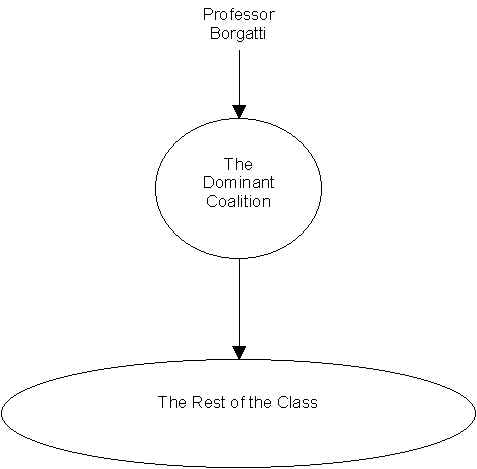
Normally, this would mean that the entire class came together. But in this case, something more complicated occurred. A dominant coalition formed -- like a new team -- which had all of these characteristics, but was separate from the rest of the class.
In addition, although I made every effort to blend into the background, I was apparently still quite salient as the ultimate leader, for this was the time when the team made comments about my photograph and about OB.
The class structure during this period -- which probably last from Nov 17 to around Nov 20 -- seems to look something like this:
Normally, this is when the group finally solves the problem or completes the task that was assigned. At this point, functional roles emerge clearly and each person in the group makes a distinctive contribution. Usually, at this point members will take initiative and accept it in others, and challenging each other leads to problem solving rather than conflict.
It is not clear that the dominant coalition reached this state fully, but clearly in the last 24 hours there were some roles.
The class as a whole was divided into 6 mutually exclusive teams which worked in parallel (that is, teams did not work divide up the labor or share work in anyway). This aspect of the class structure was more or less given by and legitimated by the instructor.
Each team had a leader. The amount of power and authority wielded by each leader varied from group to group. The official authority structure of the class looked like this:
The organization of the class project was strongly influenced by the structure of the team structure of the class. Most of the team leaders became project leaders, and most of the project leaders were team leaders. This was not imposed by the professor, but clearly team leaders were able to use their official authority as team leaders to help legitimate their claim to being project leaders.
Of course, the instructor was not the head of the team project. There was no formal head of the project. However, the initial stages of the project were clearly orchestrated by Lenny, who assumed the intitiative on his own. Later on, a kind of "dominant coalition" formed, with Lenny being a central member. Dominant coalitions are also not formal groups, and so they also do not have clear boundaries. Instead, they have a kind of core/periphery structure -- some people are more central than others. It was evident that Mark and Monica where central members. Barry and Josh seemed to be a part of the coalition. Heather G. and Sam Wholley developed important roles in it. Who were the others?
A combination of a hands-off policy on my part and the use of the listserv to communicate enabled the class to develop a class culture that was clearly its own. How could be describe this culture?
I would say that it closely resembled that of Salomon Brothers during the '80s. It was a jungle. Personal attacks of class members were common. Politics were rampant. The dominant values seemed to be toughness and coolness. Kindness, cooperation, collaboration, and inquiry were not highly valued.
How did this happen? Was it the desire of most people in the class to have this kind of a tone to the class? Probably not: culture tends to be an emergent phenomenon that is more than just the aggregate personality of the class.
The norms of the class were such that anybody could more or less say anything to anybody -- they might get retaliated against, but the right to express the sentiments were not seriously in question (at least until the end of the semester). An important aspect of successful group culture is presence of norms about what is appropriate to express and what is not.
Given the existing class culture, it is perhaps not surprising that the style of leadership that emerged was so tough.
Of course, organizations are not homogeneous. Different subgroups have different cultures. It is possible that the dominant coalition developed a different set of beliefs than the others. Judging from comments on the listserv and offhand comments after class, I would say that the dominant coalition had definite views about the rest of the class including
Who were the leaders? How did they get there? What was their style?
Most of the project leaders were team leaders. In part, this may be because the same kind of people that choose to be team leaders also choose to be project leaders. It may also be that being an official team leader provided the legitimacy needed to also be taken seriously as a project leader. This is usually the case in organizations -- people exploit their positional power (official status) to gain additional influence and opportunities.
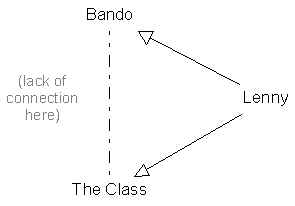
Another important source of power is connections For example, Lenny had a prior relationship with Pat Bando that made it easy for him to schedule a meeting. Lenny exploited a structural hole in the network linking Bando to the class and to the instructor:
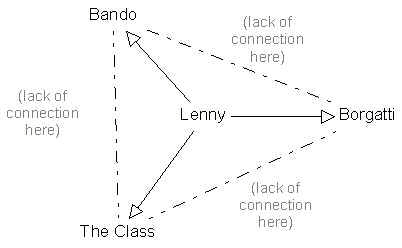
The power of connections has to do with dependence.
Sometimes just the appearance of connections is enough to gain influence and prestige. In many people's minds, Lenny was closely associated with Bando and Borgatti, in part because of mentioning Bando and Borgatti in his communications. For example, in this email:
"Excuse me, but Dinh, it seems like talking to you is like talking to a wall, it goes in one ear and out the other...If Dinh showed up to the meeting on time on Friday or e-mailed me a response stating she couldn't like the other group members did, maybe she would have understood the point of everything we are doing. I am just sick of Dinh criticising what we are doing even though both Pat Bando and Prof. Borgatti both felt that filling the needs of student employment to dining services is a genuine need of dining services and a valuable project. Prof. Borgatti said it was more than enough to pinpoint that problem, and Pat Bando also said that It was the Problem she most wanted solved, actually, it was the only problem she kept mentioning throughout our meeting on a consistent basis.""
he mentions Bando and Borgatti several times and seems to say they are supporting him or have approved his actions. It is irrelevant whether Lenny did this deliberately, or unconsciously, or by sheer coincidence. What's important is whether in people's minds, an association was set up.
Expertise is related to power in a way that is similar to connections. On the one hand, it is a direct factor in creating dependence: if you have the life-saving skills of surgeon, people will treat you with a lot of respect and pay you a lot of money. On the other hand, there is an additional benefit to expertise that is more perception based. Expertise legitimates taking power. If a person is competent, then the fact that they have taken control is ok -- somebody's got to do it, so and so knows how to do it, so let them do it. If the person who takes power is seen as not having sufficient expertise, they will have difficulty holding on to the power.
Is there a difference between having power and being a leader? Well, terminology varies, but there are clearly different roles that involve power. Some researchers like to reserve the word "leader" for certain roles and not others. Mintzberg talked about these roles:
What roles Lenny, Mark, Monica and all the rest of the dominant coalition have? Lenny seemed to have elements of several roles: figurehead, liaison, spokesperson, entrepreneur, resource allocator.
I have been told that Monica -- besides serving as spokesperson, disseminator, figurehead etc. -- also served as disturbance handler and negotiator within the dominant coalition.
There are a lot of different styles that people in charge can have. In part this is due to their personalities. Some people are very warm, talkative friendly people that want to be liked. Others, don't care about being liked but really carea about being respected. These motivations affect their management style.
It is also due to the kinds of experiences they have had in the past.
And it can be due to their view of the people they are dealing with and what those people need. This view can in turn be due to generalized theories of human behavior (Including stereotypes), or to specific knowledge about these individuals. Based on an empirical study, McGregor suggested that managers fall into two basic camps: Theory X and Theory Y. The terms refer to the kinds of theories that the managers have about people in general:
| Theory X | Theory Y |
people (workers) are
|
people (workers) are
|
Theory X managers, because of their beliefs, tend to behave in autocratic or paternalistic styles. They tend to be highly directive managers, who tell subordinates exactly what to do and then monitor them closely. They can also have bargaining styles where they try to trade good behavior by employees with rewards and suppression of punishment.
Theory Y managers, because of their beliefs, tend to adopt more participative, consulting and coaching styles. They tend to give objectives and let the subordinate pick their own path to completion. They trust subordinates and try to create the conditions under which subordinates will work well.
In this class the project leaders seem to have been primarily of the Theory X school. The emails often note that there is little reward for working on the project. The emails often accuse people of being freeloaders or of being lazy. They make clear that if the leaders hadn't stepped in, nothing would have gotten done.
However, the class leaders did not act in a completely theory x manner, because (as far as I know) they did not keep close tabs on the progress of the class. They told them what to do, but then did not check regularly to see whether it was being done. When things didn't get done, they got annoyed and commented on the lack of intrinsic motivation.
Both theory X and theory Y managers can get good results. But mixing the two styles can be a problem.
What communication difficulties were there in the class project?
One problem was that team leaders were very poor at reporting to their teams what was going on with the project. This angered class members. But I think that one reason why team leaders were bad at doing that was that they themselves were a little confused, and were afraid to admit it. They wanted to appear like they were part of the in-group, but in fact, most decisions were being made behind the scenes, in a hurry, and poorly communicated even among team leaders.
A second problem was that dominant coalition, with the help of their hangers-on, quickly established a norm of non-criticism. It became illegal to utter a suggestion, contrary view or criticism. Those who did were loudly branded whiners, criticizers, ingrates, pains-in-the-butt, etc. This effectively stopped all communication between the coalition and the rest of the class. Pretty soon you saw a lot of email messages of this type: "I just wanted to say what a great job our leaders are doing. I for one am really glad they are in charge."
Many people in the class saw the leaders as intimidating or shutting them out of the project. Especially when they voiced a suggestion.
I think this perception genuinely puzzles the leaders. In their view, they were nothing but open, becoming annoyed only at the end when people are still "criticizing" even when it is too late to change anything. In their view, they kept everyone informed, and practically begged people to participate. In fact, they resented the rest of the class, whom they regarded as freeloaders benefiting from the leaders' hard work.
Some people did not participate in the project because they figured no matter how much work they did, they would be shoved aside by the glory hogs in the end. This is kind of a self-fulfilling prophecy since in the absence of their participation, someone is going to step in to fill the vaccuum.
Some of the negative attitudes towards the leaders was probably due to stereotyping. People believe that the kind of people who choose to become leaders are often people with big egos -- manipulative ruthless bullies who are, to put it simply, not nice. The people who believe this are ready to resent these kind of people and to passively refuse to help them. The moment the leaders start to behave in ways that seem to confirm these beliefs, the followers turn off.